
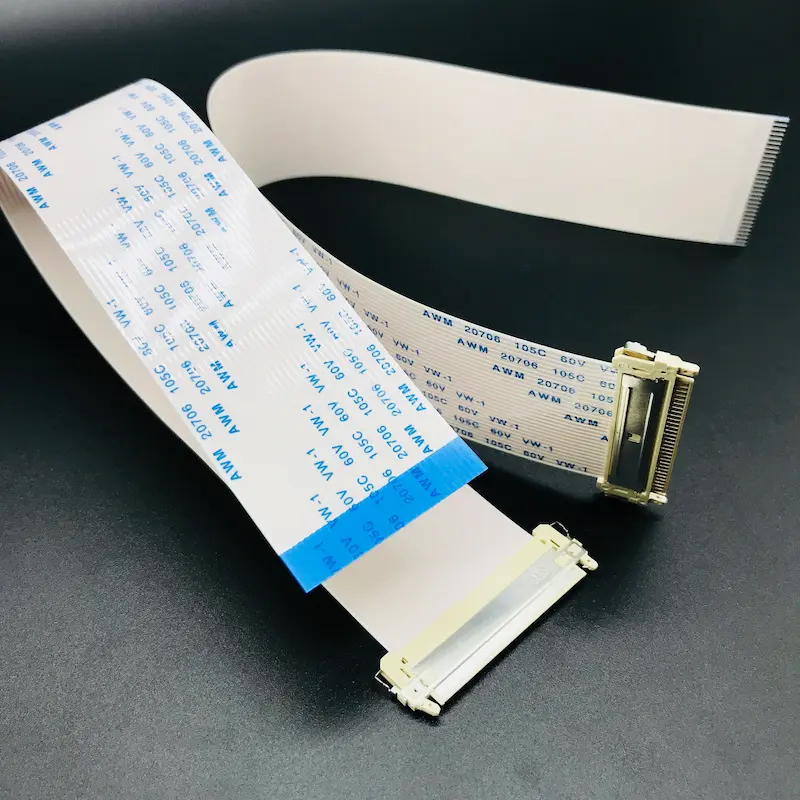
When you Modify Standard FFC Cables, you must focus on safety. If you cut through a conductor or use dull tools, you can damage the cable. You face safety risks like poor pin alignment or loss of certification. Always follow safety guidelines and trust experts for reliable results.
Key Takeaways
Always prioritize safety when modifying FFC cables. Use sharp tools, wear protective gear, and maintain a clean workspace to prevent accidents.
Measure twice and cut once. Accurate measurements ensure a perfect fit and prevent damage to conductors, which can lead to device failure.
Inspect your work after modifications. Conduct continuity tests to check for issues and ensure reliable connections before installation.
What Are Flexible Flat Cables (FFC)?
FFC Structure and Applications
You often see flexible flat cables in modern electronics because they save space and offer reliable connections. These cables use a flat, ribbon-like design that makes them easy to bend and route through tight spaces. Each cable contains parallel conductors, which help maintain signal quality and reduce interference.
Here is a table showing the main parts of flexible flat cables and the materials used:
Component | Common Materials |
|---|---|
Conductors | Copper, Aluminum |
Insulation | Polyester (PET), Polyimide (PI), PVC, Teflon (PTFE) |
Flexible flat cables appear in many industries. You find them in devices you use every day, as well as in advanced technology. The table below lists some common industries and their typical applications:
Industry | Typical Applications |
|---|---|
Consumer Electronics | Smartphones, tablets, laptops, wearables, digital cameras |
Medical Devices | MRI and ultrasound systems, patient monitors, infusion pumps, surgical robots |
Automotive Industry | Infotainment systems, driver assistance, navigation, camera feeds, sensor networks |
Aerospace and Defense | Avionics, cockpit displays, radar units, UAVs |
Industrial Machinery | Robotics, CNC machines, automated assembly lines, PLCs |
Emerging Technologies | Wearable tech, IoT devices, foldable electronics, AR headsets |
YLS FFC Product Overview
When you choose YLS, you get flexible flat cables that stand out for their quality and versatility. YLS FFCs handle temperatures from -20°C to +260°C and last for more than 20 million flex cycles. You can use them in high-speed, high-movement environments without worry.
YLS offers many customization options. You can request shielding for sensitive circuits, custom punching or notching for easy installation, and folded layouts for complex assemblies. Medical-grade insulation and gold-finished ends add extra reliability. These features make YLS flexible flat cables a smart choice for demanding projects in automotive, medical, and consumer electronics.
Tip: YLS supports custom labeling and fast prototyping, so you can match your cable exactly to your design needs.
When to Modify Standard FFC Cables
Acceptable Modifications and Limitations
You may need to modify standard ffc cables when your project requires a precise fit, unique pin configuration, or enhanced reliability. Sometimes, you want to reduce clutter inside a device or improve signal integrity for high-speed data transfer. In these cases, modifying standard ffc cables can help you achieve a better result without waiting for a custom order.
Here is a table showing common factors that lead you to modify standard ffc cables:
Factor | Description |
|---|---|
Environmental Durability | Standard FFCs may not handle stress, moisture, or EMI in tough environments |
Reinforced FFCs | Extra layers add flexibility and resist bending fatigue |
Shielded FFCs | Protect against EMI, important for medical and automotive uses |
High-Temperature FFCs | Work well in extreme temperatures |
You should also know the limitations when you modify standard ffc cables. These cables have a lower current-carrying capacity and may not suit high-power applications. They can be less durable under repeated stress and need precise alignment during installation. If you need a cable for ultra-high-density PCBs or require many mating cycles, a standard FFC may not be the best choice.
Risks of Cutting or Trimming FFC
When you modify standard ffc cables by cutting or trimming, you face several risks. You might damage the conductors, which can cause signal loss or short circuits. The cable may become more delicate and prone to damage during installation. If you do not cut straight or use the right tools, you can create uneven ends that do not fit connectors properly.
Note: Always check if your modification affects the cable’s ability to meet industry standards or regulatory requirements. Improper changes can lead to device failure or safety issues.
If you want to modify standard ffc cables safely, use sharp tools, measure carefully, and inspect your work before installation. When in doubt, consult an expert or consider ordering a custom cable for your application.
Tools and Preparation for Modifying FFC
Essential Tools for Safe Cutting
You need the right tools to modify flexible flat cables. Using flat cable cut-strip tools helps you achieve clean cuts and precise stripping. These tools include cable shears, precision scissors, and specialized stripping pliers. You can use tweezers to handle delicate cable ends. A magnifying glass or inspection lamp lets you check your work for accuracy. Flat cable cut-strip tools also include crimping tools for connector installation and small files for smoothing trimmed edges.
Here is a table showing common flat cable cut-strip tools and their uses:
Tool | Purpose |
|---|---|
Cable Shears | Cutting cable to length |
Precision Scissors | Trimming edges |
Stripping Pliers | Removing insulation |
Tweezers | Handling cable ends |
Crimping Tool | Attaching connectors |
Small File | Smoothing trimmed edges |
Tip: Always use sharp flat cable cut-strip tools. Dull blades can crush or tear the cable, which affects performance.
Workspace and Safety Setup
You must prepare your workspace before you start modifying cables. Safety is important, so you should wear eye protection and gloves. You can use tweezers or clamps to hold wires and connectors. Avoid touching the soldering iron directly. Make sure your workspace has good ventilation to prevent inhaling fumes. Wash your hands after soldering to remove residue. Review the manufacturer’s Safety Data Sheet for extra safety information. Clean your area after finishing to prevent contamination.
Here is a checklist for workspace safety:
Wear eye protection and gloves.
Use tweezers or clamps for handling.
Avoid direct contact with hot tools.
Ensure proper ventilation.
Wash hands after soldering.
Review Safety Data Sheets.
Clean workspace after finishing.
Note: A clean and organized workspace helps you avoid mistakes and keeps your project safe.
Step-by-Step: Modify Standard FFC Cables
Modifying flexible flat cables can seem challenging, but you can achieve reliable results by following a clear step-by-step guide. This section will help you master measuring and cutting, trimming, and preparing cable ends for secure connections.
Measuring and Marking for Precision
Start every modification with careful measuring and marking. You want your flat cable cut strip process to be accurate from the beginning. Use a steel ruler or digital caliper to measure the exact length you need. Mark the spot with a fine-tip permanent marker. Double-check your measurements before you make any cut. This step prevents wasted materials and ensures your cable fits perfectly.
Tip: Always measure twice and cut once. This habit helps you avoid mistakes and supports cutting precision.
When aligning the cable, make sure the conductors stay straight. If you rush this part, you may end up with uneven edges or poor connections. Take your time and keep your workspace organized. Good preparation leads to clean cuts and a professional finish.
Cutting and Trimming Techniques
Cutting flexible flat cables requires the right tools and steady hands. Use sharp flat cable cut strip tools such as precision scissors, flush-cut wire cutters, or a craft knife. Dull blades can crush or fray the cable, which leads to poor performance. Place the cable on a clean, flat surface. Secure it with tape or a clamp to prevent slipping.
Follow this step-by-step guide for best results:
Position the cable so your marked line is easy to see.
Hold your tool perpendicular to the cable for a straight cut.
Apply even pressure and cut in one smooth motion.
For thicker cables, score the insulation lightly first, then deepen the cut in stages.
Inspect the edge for clean cuts and make sure no conductors are damaged.
You may need to trim the edges after cutting. Use a small file or precision scissors to remove any rough spots. This extra step helps when inserting into connector slots and ensures a snug fit.
Here is a table of common mistakes and how you can avoid them during the flat cable cut strip process:
Design Mistake | Prevention Measures |
|---|---|
Poor understanding of project requirements | Work closely with your team to set clear requirements, including materials and specifications. |
Inadequate time allocation | Plan enough time for each step and prepare for unexpected challenges. |
Neglecting environmental factors | Think about how temperature and humidity will affect your materials during design. |
Underestimating importance of quality control | Set up strong quality control procedures and check your work regularly. |
Note: Planning and patience are just as important as the tools you use. Rushing the flat cable cut strip process can lead to errors that are hard to fix later.
Preparing Cable Ends
After cutting and trimming, you must prepare the cable ends for reliable connections. This step-by-step guide will help you get the best results:
Choose the right tool. Use sharp flush-cut wire cutters, precision scissors, or a craft knife. Avoid dull blades.
Secure the cable. Clamp it gently in a vise or use tape to hold it steady on your cutting mat.
Make a straight cut. Align your tool perpendicular to the cable and apply even pressure. For knives, score lightly first, then deepen the cut in stages.
Inspect the result. Check for clean edges and undamaged conductors. Use a magnifying glass if needed.
Prepare for connection. If you plan on inserting into connector slots like ZIF connectors, make sure the end is free of burrs or insulation residue.
You want your flat cable cut strip process to produce a cable that fits perfectly and works reliably. Clean cuts and careful preparation help prevent signal loss and ensure long-term performance.
Tip: Always inspect your work before installing the cable. Small flaws can cause big problems in electronic devices.
By following this step-by-step guide, you can handle measuring and cutting, trimming, and preparing cable ends with confidence. You will achieve professional results and maintain the integrity of your flexible flat cables.
Best Practices for FFC Modification
Avoiding Damage to Conductors
You need to follow best practices when modifying flexible flat cables. Always use the right tool for cutting and stripping. Secure the cable before you start any stripping or trimming. Make precise cuts with sharp tool blades to avoid damaging conductors. Handle the cable gently during installation. Avoid bending, twisting, or pulling connectors too much. Use cable covers or guards to protect connectors. Regularly check connectors and provide extra support to reduce stress. These safety features help you maintain cable integrity and prevent costly mistakes.
YLS supports safe modification with full customization. You can specify pitch, length, conductor count, shielding, labeling, and packaging. Custom FFC cables help you fit tight enclosures and overcome space constraints. YLS uses advanced manufacturing techniques and precise conductor layouts to ensure reliability and signal clarity. These safety features make YLS cables trusted in medical, automotive, industrial, and consumer electronics.
Post-Modification Inspection
After you finish cutting and stripping, you must inspect your work. Use a continuity test to check for broken or shorted conductors. Run a continuity test on each conductor after stripping and trimming. Look for clean edges and undamaged insulation. Perform a continuity test before installing the cable. If you find any issues, repeat the stripping process with the right tool. Always verify that the cable matches your device specifications. These best practices for optimal use help you avoid installation errors.
YLS cables meet industry standards for safety. You get medical-grade materials, biocompatibility certification, and full material traceability. YLS ensures RoHS and REACH compliance. Batch-level reports are available for regulated markets.
Compliance Aspect | Description |
|---|---|
Medical-grade materials | Materials withstand sterilization without delamination or cracking. |
Biocompatibility certification | Materials sourced with ISO 10993 or USP Class VI certification. |
Material traceability | Full traceability provided for industry standards. |
RoHS/REACH compliance | Meets environmental safety regulations. |
Batch-level reports | Optional reports for regulated markets. |
ESD and Handling Tips
You must protect flexible flat cables from electrostatic discharge. Always power off the device and disconnect it before handling. Work in a static-safe environment. Hold the cable by its edges and avoid touching the gold-plated contact fingers. Never fold, twist, or bend the cable beyond its minimum bend radius. Keep the cable flat during storage and transport. Clean your workspace and use an anti-static wrist strap or mat. Inspect the cable for visible damage before installation.
Tip Category | Handling Tips |
|---|---|
Safety & Handling Warning | Power off the device and disconnect it before handling. Work in a static-safe environment. |
Handling Best Practices | Hold the cable by its edges. Avoid folding, twisting, or bending beyond minimum bend radius. |
Pre-Installation Preparation | Clean workspace. Use anti-static wrist strap or mat. Inspect cable for damage. |
Tip: Always perform a continuity test after stripping and trimming. This step ensures your cable works reliably and meets safety standards.
Following these best practices keeps your flexible flat cables safe and ready for optimal use.
Installing Ribbon Wire Connectors
Connector Types for FFC
You have many options when choosing ribbon wire connectors for flexible flat cables. Each type offers unique advantages for your project. The table below shows two common types of ribbon wire connectors and their benefits:
Type of Connector | Advantages |
|---|---|
FFC Connectors | Cost-effective for simple connections, save space and reduce weight, support high connection density, enable flexible layouts in compact designs. |
FPC Connectors | Excel in high-density, flexible, and miniaturized systems, provide reliability in constrained spaces. |
Ribbon wire connectors help you create organized and reliable connections in electronic devices. You can use ribbon wire connectors in laptops, printers, automotive systems, and medical equipment. These connectors allow you to connect multiple conductors at once, which saves time and reduces errors. When you select ribbon wire connectors, always match the connector type to your cable’s pitch and pin count.
Tips for Secure Installation
You want every connection to be safe and reliable when installing ribbon wire connectors. Follow these steps for the best results:
Power down your device and clean your workspace. Use anti-static tools and check your cable for damage.
Hold the ribbon wire connectors by their edges. Keep the cable flat and avoid bending or creasing it.
Identify the correct orientation. Align the ribbon wire connectors with the connector slot and insert gently.
Secure the cable using a latch or adhesive. Apply steady pressure, but do not over-tighten.
Check the connection. Make sure the ribbon wire connectors sit properly, with no tension points. Test the device to confirm a solid connection.
Tip: Always double-check the alignment before you secure ribbon wire connectors. A small mistake can cause connection problems later.
By following these steps, you ensure that installing ribbon wire connectors leads to strong, long-lasting connections in your devices.
Troubleshooting Modified FFC Cables
Identifying Common Issues
You may face problems after modifying flexible flat cables. Many issues come from small mistakes during measuring, cutting, or installing. You can spot these problems early with careful testing and inspection. Here is a table showing common issues and what they mean:
Common Issue | Description |
|---|---|
Measurement Errors | Small mistakes in measuring can lead to improper fitting of the cable. |
Overlooking Current or Temperature Limits | Ignoring these limits can cause overheating and insulation failure. |
Ignoring Connector Orientation | Incorrect installation can lead to device malfunction. |
You should use several methods for testing. Start with visual inspection. Look for cracks or debris on connectors. Use a magnifier to find scratches or bad solder. Automated optical inspection uses cameras to check for misaligned connectors. Electrical testing helps you find open or short circuits. A continuity test checks if all connectors have working electrical paths. An isolation test makes sure connectors do not have unwanted links. Testing at each step helps you catch problems before they cause device failure.
Tip: Always include testing in your process. Early testing saves time and prevents bigger issues later.
Solutions and Preventive Measures
You can solve most problems with careful planning and regular testing. Follow these steps to prevent trouble:
Check the operating environment for temperature extremes and humidity before testing.
Pick cables that handle wear and tear. Test their durability.
Make sure the cable fits tight spaces. Testing for fit helps avoid stress.
Use shielding to prevent electromagnetic interference. Testing signal clarity is important.
Design for easy maintenance and replacement. Test how quickly you can swap cables.
Choose cables that allow upgrades. Testing for future needs helps you plan ahead.
Test cables in real-world conditions. Testing in the actual device gives the best results.
Work with trusted suppliers for custom options. Testing supplier samples ensures quality.
Respect the cable’s bend limits. Testing the bending radius prevents damage.
Use quality materials like polyimide and copper. Testing material strength is key.
You should always include testing as part of your routine. Testing helps you find and fix problems early. Testing also keeps your devices safe and reliable.
Note: Testing is not just for the end. Testing at every stage gives you the best chance for success.
You can safely modify FFC cables by following these steps:
Leave slack for movement.
Avoid sharp bends.
Reinforce terminals.
Protect traces.
YLS supports you with expert guidance and custom solutions. High-quality FFCs ensure long-term reliability:
Aspect | Benefit |
|---|---|
Flexibility | Withstands many flex cycles |
Material Quality | Maintains electrical strength |
For complex needs, consult YLS experts for the best results.
FAQ
How do you ensure precision when cutting FFC cables?
You achieve precision by using sharp tools, measuring twice, and marking the cable clearly. Precision helps you avoid conductor damage and ensures a perfect fit for your project.
Why is precision important for FFC cable modification?
Precision prevents signal loss, connector misalignment, and device failure. You maintain cable integrity and reliability by focusing on precision during every step of the modification process.
What tools help you achieve precision in FFC cable trimming?
Precision scissors, digital calipers, and cable shears give you the control needed for precision. You should always select tools designed for precision work with flexible flat cables.
Can you improve precision with practice?
Yes, you improve precision by practicing careful measuring, steady cutting, and consistent inspection. Precision grows as you gain experience and follow best practices for cable modification.
Does precision affect the performance of FFC cables?
Precision directly impacts performance. You reduce the risk of electrical faults and mechanical failures by maintaining precision throughout the cutting and trimming process.
How does YLS support your need for precision?
YLS offers custom FFC cables manufactured with precision. You get cables that match your specifications, ensuring precision in fit, function, and long-term reliability for your application.
What happens if you ignore precision during modification?
Ignoring precision can cause conductor breaks, poor connections, and device malfunction. You risk costly repairs and downtime when you neglect precision in cable modification.
How do you check for precision after trimming FFC cables?
You inspect the cable ends, test continuity, and verify alignment with connectors. Precision checks help you catch errors early and guarantee reliable cable performance.
Why should you choose YLS for precision FFC solutions?
YLS specializes in precision manufacturing. You benefit from advanced equipment, strict quality control, and expert support, all focused on delivering precision for your unique project needs.
What role does precision play in connector installation?
Precision ensures connectors align perfectly with cable contacts. You avoid misalignment and signal issues by prioritizing precision during installation.
How can you maintain precision in high-volume production?
You maintain precision by using automated cutting machines, regular tool calibration, and strict inspection routines. Precision remains consistent even as production scales up.
Is precision necessary for both standard and custom FFC cables?
Precision is essential for all FFC cables. You achieve reliable connections and device safety by applying precision to both standard and custom cable modifications.
How does precision relate to safety in FFC modification?
Precision reduces the risk of shorts, exposed conductors, and accidental damage. You protect both the cable and the device by maintaining precision throughout the process.
What are the signs of poor precision in FFC cable work?
Signs include uneven cuts, exposed conductors, and misaligned ends. You should correct these issues to restore precision and ensure proper cable function.
Can you use precision tools for other cable types?
Yes, precision tools work for many cable types. You achieve the best results when you match the tool to the cable and focus on precision.
How do you train your team for precision in cable modification?
You provide hands-on practice, clear guidelines, and regular feedback. Precision improves as your team learns proper techniques and understands the importance of precision.
What materials support precision in FFC cables?
High-quality copper and PET insulation support precision. You get clean cuts and reliable performance when you choose materials designed for precision applications.
How does precision affect the lifespan of FFC cables?
Precision extends cable lifespan. You reduce wear, prevent damage, and ensure stable connections by focusing on precision during modification and installation.
What industries require the highest precision in FFC cables?
Medical, automotive, and aerospace industries demand the highest precision. You meet strict standards and ensure safety by prioritizing precision in these fields.
How do you document precision in your modification process?
You keep detailed records, use checklists, and photograph each step. Precision documentation helps you track quality and improve future modifications.
Can you request precision customization from YLS?
Yes, you can request precision customization. YLS engineers work with you to deliver cables that meet your exact precision requirements.
What is the first step to achieving precision in FFC cable work?
You start with careful planning and accurate measurement. Precision begins before you make the first cut.
How does technology improve precision in FFC cable manufacturing?
Advanced machines and digital inspection tools increase precision. You benefit from consistent quality and reduced errors with modern technology.
Why is precision a core value at YLS?
YLS values precision because it ensures customer satisfaction, product reliability, and long-term success. You can trust YLS to deliver precision in every cable.
