

You often face strict data rate limits when using standard ffc and flat flexible cables. Unshielded, non-controlled FFCs usually support data rates up to 1 Gbps in short runs, but performance drops with longer cables or complex routing. The most important factors include material choice, manufacturing process, and connector design. For amateur radio or radio applications, you need reliable data transmission and must consider these limits early. If your project demands higher speeds, look for advanced options like YLS high-speed cables.
Factor | Description |
|---|---|
Material Choice | Using LCP insulation improves data rates by lowering signal loss. |
Manufacturing | Precision etching ensures consistent transmission. |
Design Flexibility | Adaptable connectors optimize performance for high-speed data. |
Key Takeaways
Standard unshielded FFC cables support data rates up to 1 Gbps for short runs. For higher speeds, consider shielded or high-speed options.
Cable length and routing significantly affect data rates. Keep cables short and avoid sharp bends to maintain signal quality.
Material quality matters. Use high-purity copper and effective insulation to enhance conductivity and reduce signal loss.
Select cables with shielding and controlled impedance for high-speed applications. This protects against electromagnetic interference and ensures reliable data transmission.
Testing and validation are crucial. Always test FFC and FPC cables to ensure they meet performance requirements before use in critical applications.
Key Factors Influencing Data Rate Limits in FFC
Pitch and Conductor Width
You need to pay close attention to pitch and conductor width when working with ffc. The pitch is the distance between each conductor. Smaller pitches, such as 0.50 mm or 1.00 mm, are recommended for impedance-controlled ffc cables. These pitches help maintain signal quality and support higher baud rate limitation. Wider conductors reduce resistance and allow digital data transmission to move faster. When you select the right pitch and conductor width, you improve the spectrum of applications and maximize the advantages of ffcs. You also minimize disadvantages of ffcs, such as signal loss and interference. Understanding how ffcs work helps you choose between an ffc and fpc for your project.
Cable Length and Routing
Cable length and routing play a major role in baud rate limitation. Longer ffc cables increase signal attenuation, which limits the spectrum of data rates. For example, copper cables can lose up to 94% of signal strength over 100 meters, while fiber cables lose only 3%. You must keep cable runs short and avoid sharp bends to maintain high-speed digital data transmission. Proper routing supports common uses of ffcs in applications like displays and sensors. You can use YLS high-speed cables with controlled impedance to reduce losses and support a wider spectrum of applications.
Material Quality and Construction
Material quality and construction affect how ffcs work and their baud rate limitation. High purity copper enhances conductivity and supports higher data rates. Effective insulation materials minimize dielectric losses, keeping the signal strong. The arrangement and spacing of conductors in ffc and fpc cables are important for signal integrity. You gain advantages of fpcs and ffcs by choosing cables with premium materials. YLS offers ffc and fpc solutions with advanced construction for demanding applications.
Signal Integrity and Crosstalk
Signal integrity and crosstalk determine the maximum baud rate limitation in ffc and fpc cables. Flat Ethernet cables can achieve up to 10 Gbps with high signal integrity and effective crosstalk mitigation. Design features such as low dielectric constant materials, shielding, controlled impedance, and proper spacing between conductors help maintain a clean spectrum. Shielded-cable and high-speed-cable from YLS use these features to support applications that require reliable digital data transmission. You should consider types of ffcs and fpcs that offer these protections when choosing between an ffc and fpc.
Tip: Always select ffc or fpc cables with shielding and controlled impedance for high-speed applications. This reduces disadvantages of ffcs and fpcs, such as EMI and signal degradation.
Typical Data Rate Limits for Flat Flexible Cables
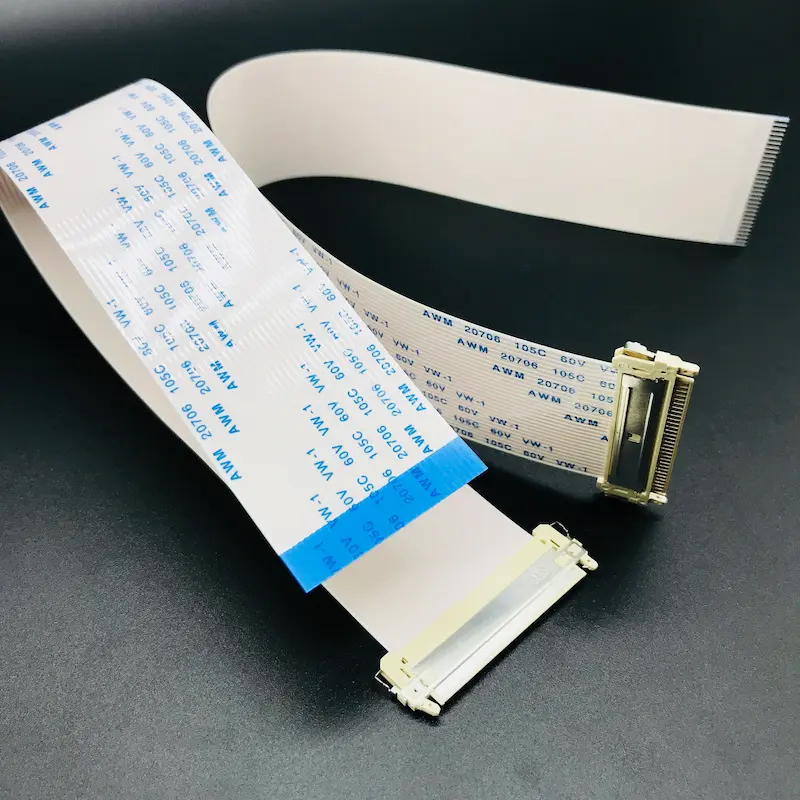
Common FFC Specifications and Data Rates
You need to know the typical data rate limits for flat flexible cables before you start your design. Standard unshielded ffc cables usually support data rates up to 1 Gbps for short runs under 300mm. If you use longer cables or route them through noisy environments, the data rate limits drop quickly. When you require higher speeds, you must upgrade to shielded or controlled-impedance constructions.
Here is a table showing common ffc specifications and their maximum data rate limits:
Cable Type | Maximum Data Rate | Pitch Sizes |
|---|---|---|
LVDS FFC | Up to 10 Gbit/sec | 1.0mm, 0.5mm |
High Speed FFC | Up to 17 Gbit/sec | 1.0mm, 0.5mm |
You should select the cable type and pitch based on your application’s speed requirements. If your project needs more than 1 Gbps, you must consider shielded or high-speed ffc options.
Note: Always check the cable length and routing. Longer cables and sharp bends reduce data rate limits and signal quality.
Protocol Support: LVDS, USB, HDMI, MIPI
Flat flexible cables support many high-speed protocols. Each protocol has unique requirements for data rate limits and cable construction. You must match the protocol to the right ffc design.
Protocol | Data Rate Capability | Characteristics |
|---|---|---|
LVDS | Up to 6 Gbps | Differential signaling, low voltage, twisted pairs to reduce noise |
USB | Up to 6 Gbps | High-speed data transfer, widely used in various devices |
HDMI | Up to 6 Gbps | Supports high-definition video and audio transmission |
MIPI | Up to 6 Gbps | Optimized for mobile devices, low power consumption |
LVDS uses differential signals to minimize electrical noise. You need cables with controlled impedance for reliable performance.
USB requires high-speed data transfer. You must use ffc cables with precise construction for error-free operation.
HDMI transmits high-definition video and audio. You need cables that support high data rates and shielding.
MIPI is optimized for mobile devices. You must select flexible and compact ffc cables for these applications.
Tip: If your protocol needs more than 1 Gbps, always choose shielded or controlled-impedance ffc cables to maintain signal integrity.
YLS High-Speed Cable Performance
YLS high-speed ffc cables give you reliable performance for demanding applications. You can achieve data rate limits up to 6 Gbps with YLS high-speed cable solutions. These cables support protocols like LVDS, USB, HDMI, and MIPI. You get controlled impedance, low signal skew, and optional shielding. You can customize pitch, pin count, and length to fit your project.
YLS high-speed cables meet industry standards such as ISO9001:2008 and RoHS. You can use them in displays, cameras, embedded systems, and automotive electronics. When you need to push data rate limits beyond standard ffc capabilities, YLS high-speed cables provide the solution.
🚀 Upgrade to YLS high-speed ffc cables when your project requires data rates above 1 Gbps or must operate in EMI-sensitive environments.
Practical Challenges for FFC and FCC Data Rates
EMI/EMC and Environmental Factors
You face many challenges when using ffc and fcc in high-speed radio and amateur radio applications. Electromagnetic interference can disrupt data transmission, especially in emergency response communications. Particulation, or the buildup of small particles, can interfere with signals. Electrostatic discharge may damage sensitive components and attract more particles, making the problem worse. You need effective shielding to protect your ffc and fcc from these issues. Environmental factors like temperature and humidity also affect reliability. If you work in emergency situations or the amateur radio community, you must choose cables that maintain stable connections during temperature swings or moisture exposure. YLS shielded-cable and automotive cable offer strong EMI protection and perform well in harsh environments.
Connector Quality and Reliability
Connector quality plays a big role in the long-term performance of ffc and fcc systems. A good connector keeps your radio or amateur radio project running smoothly. ZIF connectors work well for high-cycle uses because they reduce wear. Non-ZIF connectors can be reliable for permanent setups and may resist vibration better. The weakest part of a connector, such as the transition zone or conductor resistance, can limit data rates over time. You should always select connectors that match your application’s needs, especially for critical radio or emergency uses. Reliable connectors help prevent signal loss and keep your ffc and fcc working in demanding conditions.
Flexible Printed Circuits vs. FFC
You often need to compare flexible printed circuits and ffc when planning high-speed applications. Both options support radio and amateur radio community projects, but they have key differences. Flexible printed circuits use multilayer designs, which allow higher data rates than most ffc. Ffc can reach up to 17 Gbit/sec, but flexible printed circuits often go higher because of their complex structure. Here is a quick comparison:
Type of Cable | Maximum Data Rate |
|---|---|
Flat Flexible Cables (FFC) | Up to 17 Gbit/sec |
Flexible Printed Circuits | Generally higher |
You see common uses of fpcs in advanced electronics, where high speed and reliability matter most. The differences between ffcs and fpcs become clear when you need to handle more data or work in tough environments. Fpc also offers more design flexibility for complex layouts. If you need strong EMI protection, YLS shielded-cable and automotive cable work well for both ffc and fpc applications. Always review the differences between ffcs and fpcs before making your final choice.
Tip: For emergency or amateur radio projects, select the cable type that matches your speed and reliability needs. Flexible printed circuits give you more options for high-speed and complex designs, while ffc offers simplicity and cost savings.
Optimizing Data Rate Limits with YLS FFC Solutions
Design Recommendations for Flat Flexible Cables
You can optimize data rates in your radio and amateur radio projects by following a few key design steps. Start by choosing impedance-matched ffc designs, such as 100-ohm cables, to keep signal quality stable. Select ffc with EMI-optimized shielding when you work in environments with high interference. Use temperature-resistant insulation if your ffc or fpc will face extreme conditions. For applications that require frequent movement, pick cables with high resistance to vibration and bending. YLS Display cable and Zif cable offer these advantages, making them ideal for displays, sensors, and compact radio modules. Upgrade from basic ffc to shielded or reinforced types when your data rates approach 1 Gbps or when you see signal loss. Early in your design, review the disadvantages of unshielded ffc and consider the advantages of custom solutions from YLS.
Design Feature | Benefit |
|---|---|
Impedance-matched ffc | Stable signal quality, high data rates |
EMI-optimized shielding | Protection from interference |
High flex life | Reliable under vibration and bending |
Temperature-resistant | Works in harsh environments |
Shielding and Grounding with YLS Products
Shielding and grounding play a big role in maintaining high data rates for ffc and fpc. YLS Shielded-cable uses dense material coverage and advanced outer jackets to block both internal and external interference. This helps you avoid common disadvantages like signal degradation and crosstalk in radio and amateur radio applications. Choose the right AWG gauge size for your ffc to balance flexibility and signal quality. Shorter ffc and fpc cables reduce signal loss, so keep your cable runs as short as possible. For fcc and fpc in noisy environments, always select shielded options to maximize the advantages of your design.
Testing and Validation for Reliable Performance
You need to test every ffc and fpc before using them in critical radio or amateur radio systems. YLS uses continuity testing to check for breaks, insulation resistance testing to prevent shorts, and time-domain reflectometry to find faults. Signal integrity and crosstalk measurements ensure your ffc or fpc meets high-speed requirements. These tests help you avoid disadvantages like unexpected failures and keep your radio and amateur radio applications running smoothly. YLS offers OEM/ODM services, so you can customize your ffc, fpc, or fcc for any application and get reliable performance every time.
Tip: Upgrade to shielded or reinforced ffc early in your design if you expect high data rates, long cable runs, or harsh environments. This helps you avoid costly redesigns and ensures your radio and amateur radio projects succeed.
You see that standard ffc cables usually support data rates up to 1 Gbps for short runs. Upgrading to shielded or high-speed ffc lets you reach up to 6 Gbps. YLS products help you achieve optimal performance by offering high flex cables that maintain consistent results, shielding that protects against EMI, and strict quality control for reliability. You can consult YLS for custom ffc solutions and technical support that fit your project needs.
High flex cables reduce downtime.
Shielding ensures clear signal integrity.
Quality control boosts reliability.
Reach out to YLS for expert guidance on ffc selection and upgrades.
FAQ
What is the maximum data rate you can expect from a standard FFC?
You can expect up to 1 Gbps for short runs with standard, unshielded FFC cables. For higher speeds, you should use shielded or high-speed FFCs, like those from YLS, which support up to 6 Gbps.
How does cable length affect data rate in FFCs?
Longer cables cause more signal loss and reduce the maximum data rate. You should keep FFC cables as short as possible to maintain high-speed performance and reliable data transmission.
Why should you consider shielding for high-speed FFC applications?
Shielding protects your signals from electromagnetic interference (EMI). You get better signal integrity and fewer errors, especially in environments with lots of electronic noise. YLS Shielded-cable options help you achieve this.
Can you customize FFC cables for specific data rate needs?
Yes, you can. YLS offers custom pitch, length, pin count, and shielding options. Customization lets you match the cable to your exact data rate and application requirements.
Which protocols work best with high-speed FFC cables?
Protocols like LVDS, USB, HDMI, and MIPI work well with high-speed FFC cables. You should choose cables with controlled impedance and shielding to support these protocols and maintain reliable data transfer.
