
Automotive Grade FFC connects electronic systems inside cars and supports advanced features like displays, sensors, and lighting. You see these cables in vehicles because they offer flexibility, durability, and space-saving design. The global market for automotive flexible flat cables now stands at around $4.5 billion, with a projected annual growth rate of 7% in the coming years.
Choosing cables that meet strict industry standards keeps vehicles safe and reliable. The table below shows why these standards matter:
Evidence Point | Description |
|---|---|
High Heat Resistance | These cables withstand high temperatures, which is crucial for safety. |
Material Advancements | New materials increase strength and durability for automotive wiring. |
Manufacturing Techniques | Automated processes create consistent, high-quality cables for vehicles. |
YLS provides automotive-grade flexible flat cables and offers expertise in customization. When you select cables for your vehicle, consider how industry standards affect long-term performance and safety.
Key Takeaways
Automotive Grade FFC cables are essential for connecting electronic systems in vehicles, offering flexibility and durability.
Choosing cables that meet industry standards like ISO and AEC-Q200 ensures safety and reliability in automotive applications.
Advanced materials like PVC and TPU enhance the performance of automotive FFC, making them resistant to heat and chemicals.
Customization options from suppliers like YLS allow you to tailor cables to specific automotive needs, improving functionality.
Always verify certifications and supplier reliability to ensure the cables you choose meet safety and performance standards.
What Is Automotive Grade FFC
Construction and Materials
You will find that automotive grade FFC uses advanced materials to meet the tough demands of vehicle environments. These cables must handle high temperatures, chemicals, and constant movement. Manufacturers select materials that boost both safety and performance.
Here is a table showing the main materials and how they help the cable perform:
Material | Contribution to Performance |
|---|---|
PVC | Provides strong insulation and protects against heat, chemicals, and moisture. |
XLPE | Offers excellent insulation and works well in harsh conditions. |
Elastomers | Increases flexibility, which helps the cable bend and twist without damage. |
TPU | Adds even more flexibility, making the cable perfect for moving parts and dynamic systems. |
You can see that each material brings a unique benefit. PVC and XLPE keep the cable safe from heat and chemicals. Elastomers and TPU make the cable flexible, so it can move with the car’s parts without breaking.
Unique Features
Automotive grade FFC stands out because it combines flexibility, durability, and smart design. You get a cable that fits into tight spaces and handles constant motion. These features make it a top choice for modern vehicles.
Tip: When you choose automotive grade FFC, you solve many wiring challenges in one step.
Some unique features include:
High flex life: The cable bends and moves for years without failing.
Superior heat dissipation: The flat shape lets heat escape quickly, keeping the cable cool.
Lightweight and low profile: The thin design saves space and reduces vehicle weight.
Durability: The cable can flex up to 5 million times, which is perfect for moving parts.
Foldable: You can fold the cable to fit complex routes inside the car.
Multiple termination options: You can connect the cable using different methods, such as hot bar soldering or special connectors.
Point-to-point wire replacement: The cable makes it easy to connect different parts of the car.
You also get better signal quality and less noise compared to round cables. The design allows for efficient packaging, which means you can fit more technology into smaller spaces. The cable can carry more current without overheating, thanks to its ability to release heat quickly.
Comparison to Standard FFC
You might wonder how automotive grade FFC compares to standard FFC. The main differences come from the materials, durability, and special features.
Automotive grade FFC uses materials like PVC, XLPE, elastomers, and TPU for extra protection and flexibility. Standard FFC may not use these advanced materials.
Automotive grade FFC handles higher temperatures and more movement. Standard FFC works best in stable, less demanding environments.
Automotive grade FFC offers better heat dissipation, which helps prevent overheating in cars.
You get more options for connecting and routing with automotive grade FFC. Standard FFC may not fold or flex as much.
If you need a cable for a car, you should choose automotive grade FFC. It gives you the safety, reliability, and performance that vehicles demand.
Industry Standards for Automotive Grade FFC
ISO and AEC-Q200
You need to understand the role of ISO and AEC-Q200 standards when you select Automotive Grade FFC for your vehicle. ISO standards, such as ISO 6722, set the requirements for road vehicle cables. These standards define how cables should perform under high temperatures, chemical exposure, and mechanical stress. ISO 6722 covers both 60V and 600V cables, which you often find in modern vehicles.
AEC-Q200 is another important standard. It focuses on the reliability of passive electronic components, including cables. When you see AEC-Q200 compliance, you know the cable has passed rigorous tests for temperature cycling, vibration, and humidity. This means you can trust the cable to work in tough automotive environments.
You should look for these certifications because they show that the cable meets global safety and performance benchmarks. Manufacturers who follow ISO and AEC-Q200 standards deliver products that last longer and perform better in your car.
IPC/WHMA-A-620
IPC/WHMA-A-620 sets the quality standards for cable and wire harness assemblies. When you choose Automotive Grade FFC that meets this standard, you get several benefits:
You see uniform quality across different batches.
You know the manufacturer applies proper quality measures.
You experience better communication between suppliers and manufacturers.
You get reliable products with fewer defects.
You benefit from higher production efficiency.
Manufacturers who comply with IPC/WHMA-A-620 show technical competence and consistency. You can trust their dedication to quality, which helps you select the right supplier for your automotive needs. This standard also complements broader systems like ISO certification, giving you extra assurance.
Automotive-Specific Standards
Automotive Grade FFC must meet several automotive-specific standards. These standards focus on the unique challenges inside vehicles, such as vibration, temperature changes, and electrical noise. Here is a table that summarizes some key standards:
Standard | Description |
|---|---|
LV 214-1 | Automotive – Connectors; Instruction |
USCAR 21 | Performance Characteristics for Wire-to-Terminal Electrical Mixtures |
You also need to know about ISO 6722 and SAE J1128. These standards define the performance criteria and material properties for automotive cables. Certification from organizations like UL and VDE gives you confidence in the safety and reliability of the cables you use.
When you choose cables that comply with these standards, you ensure they can handle extreme conditions. You protect your vehicle’s electronics from high temperatures and constant vibrations. You also make sure the cables integrate smoothly with other vehicle systems.
Note: Compliance with automotive standards is not just a box to check. It is a guarantee that your cables will perform safely and reliably, even in the harshest environments.
You should always select Automotive Grade FFC that meets these industry standards. This choice helps you avoid failures, reduces maintenance costs, and keeps your vehicle running smoothly.
Importance of Standards in Automotive Grade FFC
Safety and Reliability
You want your vehicle to stay safe and reliable every time you drive. Standards for Automotive Grade FFC help you reach this goal. These standards make sure the cables in your car work well and last a long time. When manufacturers follow strict rules, you get cables that resist heat, vibration, and wear.
Here is how following standards helps reduce failures in vehicles:
Evidence Supporting Reduced Failure Rates in Automotive Applications |
|---|
Reduces the risk of field failures or product recalls, enhancing customer satisfaction and brand reputation |
Maintains consistent quality across manufacturing sites through rigorous QC processes and standardization |
Strengthens vehicle safety and long-term operational reliability by minimizing electrical malfunctions and ensuring system integrity |
Enhances automotive electrical reliability by ensuring stable signal transmission, EMI shielding, and secure connectivity |
You can see that standards do more than just set rules. They protect you from electrical problems and costly repairs. Automotive grade flexible flat cables also bring extra benefits:
Their flexibility allows for efficient routing, reducing clutter and weight in vehicle interiors.
They support high-speed signals and meet durability and EMI standards.
When you choose cables that meet these standards, you help keep your car safe and dependable.
Performance in Harsh Environments
Your car faces tough conditions every day. It deals with extreme heat, cold, and constant movement. Automotive Grade FFC must perform well in these harsh environments. Standards make sure the cables can handle these challenges.
Check out the performance data for these cables:
Property | Value |
|---|---|
Temperature Range (°C) | -20 to +260 |
Flex Life Cycles | > 20 million |
Maximum Acceleration (m/sec²) | > 40 |
Minimum Bend Radius | > 10 x 100 |
Jacket Material | PTFE |
You can trust these cables to work even when the temperature changes quickly or the car shakes on rough roads. The high flex life means the cables bend and move millions of times without breaking. The strong jacket material protects the wires inside. By choosing cables that meet industry standards, you make sure your vehicle’s electronics stay strong and reliable, no matter where you drive.
YLS Automotive Grade FFC Features
Customization and Flexibility
You can tailor YLS cables to fit your exact automotive needs. YLS offers a wide range of customization options, so you get the right cable for your application. You can choose special pitch sizes, pin counts, materials, and even colors. If you need unique connector combinations or features like overmolding, stiffeners, or mounting clips, YLS can provide them. These options help you solve wiring challenges in infotainment systems, EV control units, and camera modules.
Here is a table showing some customization options:
Customization Option | Details |
|---|---|
Up to 105°C | |
Vibration Resistance | Yes |
Compliance | ISO/IATF16949-compliant materials |
Custom Features | Overmolding, stiffeners, mounting clips |
Application Areas | Infotainment, EV units, camera modules |
You can rely on YLS to deliver cables that match your project’s requirements, no matter how complex.
High-Speed and Shielded Designs
You need cables that support fast data transfer and protect against interference. YLS designs Automotive Grade FFC with advanced shielding options, including foil, mesh, and hybrid types. These shields block electromagnetic interference (EMI) and keep your signals clear. You also benefit from controlled impedance and low signal skew, which means your data moves quickly and accurately.
The table below highlights key features:
Feature | Description |
|---|---|
Shielding Type | Foil, mesh, hybrid |
Protocol Support | LVDS, MIPI, USB, HDMI up to 6 Gbps |
Controlled Impedance | Maintains signal quality at high speeds |
Low Signal Skew | Reduces timing issues in data transmission |
You can use these cables in advanced automotive electronics, such as displays and sensors, where speed and reliability matter most.
Durability and Environmental Resistance
You want cables that last in tough automotive environments. YLS tests its cables for durability, temperature resistance, and chemical resistance. These tests make sure the cables work well even when exposed to vibration, heat, oils, and other harsh conditions. The cables resist corrosion and abrasion, so you get long service life.
Here is a table showing how YLS cables stand up to tough conditions:
Feature | Description |
|---|---|
Temperature Rating | -40°C to 125°C |
Vibration Resistance | Designed for reliable car harness operation |
EMI Shielding | Blocks interference for clear signals |
Chemical Resistance | Resists oils and chemicals |
You can trust YLS cables to perform in any climate or driving condition. YLS also meets important certifications like ISO9001:2008 and RoHS, so you know you are getting safe and reliable products.
Applications of Automotive Grade FFC
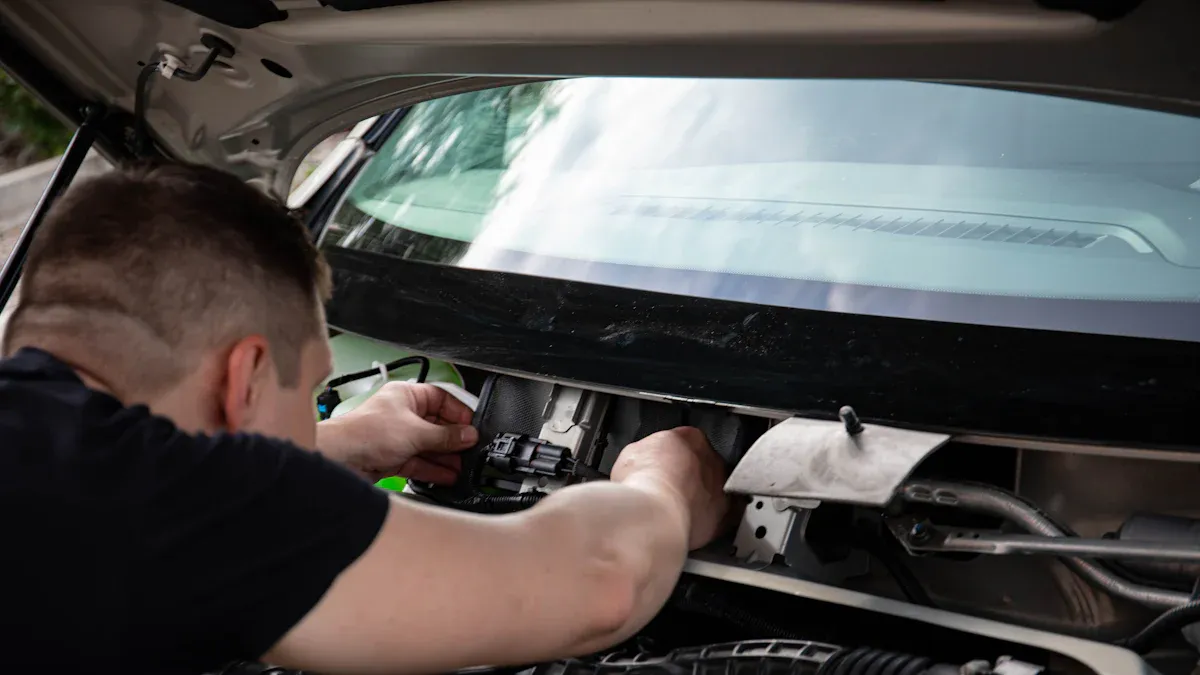
Displays and Infotainment
You see Automotive Grade FFC used in many parts of your car’s display and infotainment systems. These cables help connect different electronic parts, making sure everything works smoothly. You find them in:
Touchscreen displays, where they connect curved or foldable screens to the main control unit. This lets you enjoy modern, stylish dashboards.
Control panels for audio and climate controls. The cables link buttons and knobs, saving space and giving you reliable performance.
Connectivity modules, which support Bluetooth, Wi-Fi, and 5G. The cables fit into tight spaces and allow fast data transfer.
Ambient lighting systems, where the cables run along curved edges. This gives your car a uniform and attractive glow.
You benefit from these features every time you use your car’s entertainment or control systems.
Sensors and ADAS
You rely on sensors and advanced driver-assistance systems (ADAS) for safety and comfort. Automotive Grade FFC plays a key role in these systems. You get:
Reliable data transmission between sensors and control units. This helps your car react quickly to changes on the road.
Flexibility and durability, which are important when cables face extreme heat, cold, or vibration.
Low-latency and high-precision signal transmission. This ensures your car’s motor control and sensor networks work with accuracy.
You trust these cables to keep your car’s safety features running at their best.
Lighting and Power Systems
You need strong and flexible wiring for your car’s lighting and power systems. Automotive Grade FFC and flexible printed circuit cables handle vibration and shock well. Their slim shape lets you fit them into tight spaces, which makes wiring more efficient. You get reliable electrical connections for headlights, taillights, and interior lights. In electric vehicles, these cables also help with power distribution in battery cells. Their lightweight design improves energy efficiency and supports the latest automotive technology.
Selecting YLS Automotive Grade FFC
Certification and Documentation
When you select cables for your automotive project, always check for proper certifications and documentation. These documents prove that the cables meet strict safety and quality standards. You should look for certifications like UL, CE, TÜV, and RoHS. Each one shows that the cable passed important tests for safety, environmental protection, and performance.
Certification | Description |
|---|---|
UL | Ensures safety and performance standards for electrical products. |
CE | Indicates compliance with health, safety, and environmental protection standards. |
TÜV | Certifies that products meet specific safety and quality standards. |
RoHS | Restricts the use of specific hazardous materials in electrical and electronic products. |
You should also ask for Certificates of Compliance. These documents help during audits and show that your cables follow industry rules. Many cities and industries require these certifications for automotive applications.
Supplier Evaluation
Choosing the right supplier is just as important as picking the right cable. You want a partner who delivers quality and reliability every time. When you evaluate suppliers, check their electrical performance, flexibility, and durability. Make sure the cables fit your design and meet your project’s needs.
Criteria | Description |
|---|---|
Electrical Performance | Conductivity, voltage capacity, and insulation durability. |
Flexibility & Durability | Bending radius and lifespan under repetitive motion. |
Size & Weight | Compact and lightweight for easy installation. |
Compatibility | Works with your connectors and systems. |
Cost & Lead Time | Competitive pricing and fast delivery. |
Vendor Support & Certification | Technical support and industry certifications. |
Innovation & Customization | Ability to create custom solutions for your needs. |
Tip: Always choose suppliers who provide strong technical support and have a proven record of compliance.
Custom Solutions
Every automotive project has unique requirements. YLS helps you meet these needs with custom solutions and rapid prototyping. You start with a consultation to discuss your project. YLS engineers design and build a prototype that matches your exact needs. They test the cable for compliance with automotive standards. After testing, they make any needed adjustments before moving to full production.
Step | Description |
|---|---|
1 | Initial consultation to understand your requirements |
2 | Design and engineering of a tailored cable |
3 | Prototyping to create a working model |
4 | Testing for compliance with automotive standards |
5 | Final adjustments based on test results |
6 | Production and delivery of your custom cables |
You can use these custom cables in infotainment systems, ADAS sensors, steering modules, and more. YLS ensures that every Automotive Grade FFC meets your technical and safety needs.
You play a key role in ensuring your vehicle’s safety and performance by understanding Automotive Grade FFC and the importance of industry standards. These cables support reliable connections, resist wear, and last through millions of flex cycles. When you choose YLS, you gain access to high-performance, customizable solutions that meet strict certifications. Always prioritize certified products and consult with experts to achieve the best fit for your automotive needs.
FAQ
What is the main advantage of using automotive grade FFC in vehicles?
You get reliable performance in harsh environments. Automotive grade FFC resists heat, vibration, and chemicals. This cable supports high-speed data and fits tight spaces. You improve safety and efficiency in your vehicle.
How do you know if an FFC cable meets automotive standards?
Always check for certifications like ISO, UL, or RoHS. Ask your supplier for compliance documents. Certified cables ensure safety, reliability, and long-term performance in automotive applications.
Can you customize YLS automotive grade FFC for unique projects?
Yes, you can. YLS offers custom pitch, length, pin count, and shielding. You can request special connectors or features. YLS engineers help you design a cable that fits your exact needs.
Where do you commonly use automotive grade FFC in cars?
Displays and infotainment systems
Sensors and ADAS modules
Lighting and power distribution
You find these cables in many electronic systems that require flexibility and durability.
