
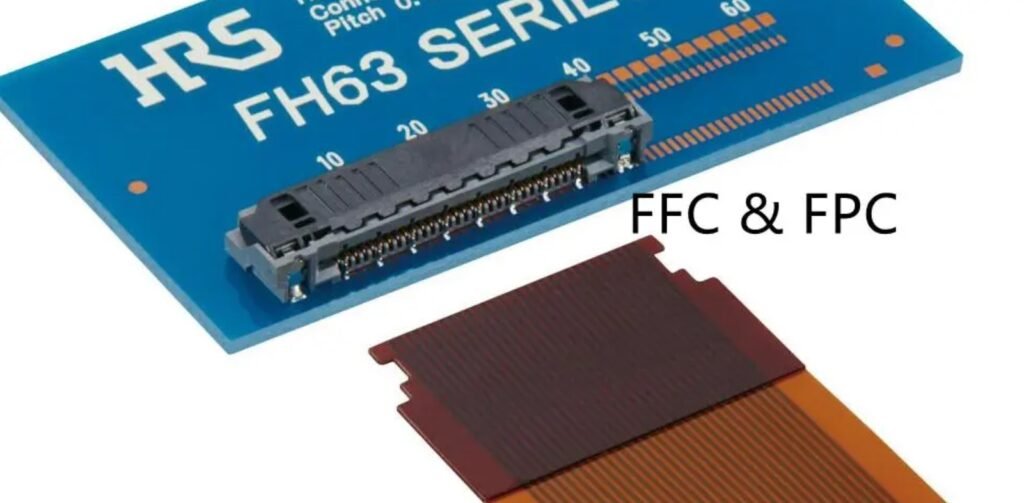
If your design pushes multi‑Gbps signals through a tight enclosure, the FFC vs FPC choice will make or break your signal integrity, EMI profile, and delivery schedule. This 2026 guide gives you a concise comparison, then maps real‑world scenarios so you can pick with confidence—without overspending or slipping timelines.
What’s the difference in plain terms?
- FFC (Flat Flexible Cable) is a pre‑made ribbon: parallel flat copper conductors laminated in PET/polyester, usually single‑layer, standardized pitches (commonly 0.3–1.25 mm), and meant for ZIF/LIF connectors. Customization exists but is limited.
- FPC (Flexible Printed Circuit) is a custom flex PCB: etched copper on polyimide (PI) or LCP, supports multi‑layer routing, vias, fine pitch (~0.3–0.5 mm), controlled impedance, shielding, and complex 3D paths.
For foundational differences and performance envelopes, see the 2025 overview in the Romtronic FFC vs FPC guide (2025‑05‑07), which notes FPC’s multi‑GHz/≈25 Gbps potential with controlled impedance, while FFCs shine in simpler point‑to‑point links with standardized connectors and lower cost.
FFC vs FPC at a glance
| Attribute | FFC (Flat Flexible Cable) | FPC (Flexible Printed Circuit) |
|---|---|---|
| Typical materials | PET/polyester insulation; flat copper conductors | Polyimide or LCP substrate; etched copper traces |
| SI/EMI capability | Adequate for moderate, short high‑speed runs with shielded 90/100 Ω options; narrower design window | Strong SI/EMI control via reference planes, differential pairs, stitching vias, shielding films; proven up to multi‑GHz/≈25 Gbps |
| Common pitches | 0.3–1.25 mm (ZIF/LIF ecosystem) | 0.3–0.5 mm common; broader options with custom design |
| Bend radius (rule‑of‑thumb) | Larger; often ≈10× thickness for dynamic use (varies by make) | Tighter; single/double‑sided ≈≥6× thickness (static); multilayer ≈≥12× (per IPC‑2223 guidance via All Flex) |
| Flex life | From thousands to millions of cycles depending on product; verify vendor data | Engineered for dynamic flex with RA copper, neutral‑axis design, and test per IPC methods |
| Connectors | ZIF/LIF as standard; economical and widely available | ZIF/LIF plus high‑density board‑to‑board options with impedance control |
| Customization | Limited pathways; no vias/components | High—multilayer, vias, components, shields, rigid‑flex |
| Lead time (2026) | Often 1–2 weeks for stocked specs; low/no NRE | Prototypes ~10–24 days; production ~4–12 weeks; NRE/tooling required |
| MOQs/cost | Low MOQs; generally lowest unit cost | Higher MOQs; NRE in low thousands to tens of thousands USD (design‑dependent) |
| Best for | Short, simple links; cost‑sensitive builds; fast turns | Complex high‑speed routing; tight spaces; EMI‑sensitive systems |
Evidence and references: Romtronic 2025; Molex Premo‑Flex controlled‑impedance FFC datasheet (2024–2025); PCBmaster FPC connector guide (2025‑12‑15); All Flex design guidance citing IPC‑2223 (2024); PICA Manufacturing reliability testing (2025–2026); GlobalSources comparison (2025).
High‑speed SI/EMI: when FFC is enough and when FPC is safer
If your link is short and moderately fast, a controlled‑impedance FFC can be a practical, low‑risk choice. Vendors such as Molex provide 90 Ω and 100 Ω FFC jumpers aimed at LVDS, USB, and HDMI classes. Keep the run short, use shielding as needed, and match the connector spec. According to the Molex Premo‑Flex datasheet (2024–2025), 90 ±10 Ω differential options exist at 0.5 mm pitch for LVDS/USB, with 100 Ω variants for HDMI‑class signaling.
Choose FPC for higher data rates, longer runs, or EMI‑sensitive environments where you need reference planes and tightly controlled impedance across the entire route, differential pair discipline with consistent spacing and return paths, and stitched shielding to contain emissions and crosstalk. The Romtronic 2025 review documents flex‑PCB designs achieving multi‑GHz and around 25 Gbps when built with proper stack‑ups and controls. Practically speaking, once you cross the 6–10 Gbps short‑link comfort zone or add length/complexity, FPC gives you more knobs to manage insertion loss, return loss, and EMI.
Tip: Think of FFC as a well‑behaved jumper for short, standardized paths. FPC is a miniature, engineered flex PCB where you can architect the return path, reference planes, and shielding.
Connectors and mechanical realities you can’t ignore
ZIF/LIF pitches of 0.3, 0.5, and 1.0 mm are common baselines for both FFC and FPC connector families, with broader ranges available. PCBmaster’s 2025 connector guide catalogs these prevalent options and emphasizes FPC compatibility when space and SI matter.
For bend radius and flex life, All Flex (2024) citing IPC‑2223 advises static bend radii of ≥6× thickness (single/double‑sided) and ≥12× for multilayer. Dynamic flexing calls for rolled‑annealed copper, careful neutral‑axis placement, and via staggering. PICA Manufacturing (2025–2026) outlines dynamic test practices aligned with IPC‑6013/2223. For ZIF terminations, specify polyimide stiffeners and relief features to prevent copper work‑hardening at the clamp edge—especially important in dynamic applications.
Secondary note on materials and thermal: FFCs typically use PET with common limits around ≤105 °C. FPCs use PI or LCP, supporting ≥150–260 °C and offering lower moisture uptake and better stability at high frequency, as outlined in Romtronic 2025.
Cost and lead time in 2026: what to expect before you quote
Directionally, costs and timelines diverge:
- FFC: Standardized inventory, minimal NRE, quick turns. Prototypes and production for stocked configurations often ship in about 1–2 weeks. MOQs can be as low as single‑digit units. Qualitative pricing comparisons in 2025 show many FFCs under a dollar in high volume.
- FPC: Custom photolithography and potential multilayer stacks introduce NRE. In 2026, plan for prototypes in roughly 10–24 days, and production windows of ~4–12 weeks depending on layer count, impedance coupons, and yield. NRE/tooling commonly ranges from low thousands to tens of thousands USD.
These planning ranges consolidate insights from the GlobalSources knowledge page (2025) and vendor notes. Always time‑stamp your quotes and ask for impedance coupons and test specifics when SI is a priority.
Scenario‑based recommendations (no single “winner”)
- Best for short, high‑speed display link (0.5 mm ZIF, 6–10 Gbps)
- Pick: High‑speed FFC with 90/100 Ω differential impedance, short length, and optional shielding.
- Checklist: Verify connector impedance; keep pairs adjacent; minimize stubs; validate length in SI sim or vendor notes.
- Best for compact gimbal with repeated bending
- Pick: FPC with PI or LCP, RA copper, reference planes, and stitched shielding; obey IPC‑2223 bend radii.
- Checklist: Define dynamic bend radius; set neutral‑axis at copper; specify stiffeners; validate via IPC‑style dynamic tests.
For cost‑optimized consumer modules with modest data rates, a short paragraph beats another list: Choose standardized FFC with off‑the‑shelf ZIF connectors. Keep runs short and add shielding if enclosure noise is high. Confirm stocked pitches/lengths early, validate EMI in‑enclosure, and check MOQ/lead time so the schedule holds.
Brief alternatives when neither fits
For very high data rates over longer lengths or harsh EMI, micro‑coax or twinax assemblies can outperform both FFC and FPC. Vendor connector matrices outline options purpose‑built for SI at high frequencies.
FAQ
- How many times should I repeat the primary keyword “FFC vs FPC” in specs and documentation?
- Use it naturally—title, one subheading, and a handful of times in copy are enough. Focus on the data rate, length, pitch, and impedance requirements.
- What minimum bend radius should I assume before lab tests?
- Start with IPC‑style rules of thumb: single/double‑sided flex ≥6× thickness for static bends and ≥12× for multilayer. For dynamic use, increase conservatism and select RA copper; validate per IPC‑aligned tests.
- Can FFC handle 10+ Gbps links?
- Sometimes, for short runs with shielded, controlled‑impedance designs and the right connectors. Molex’s 90/100 Ω FFC jumpers target LVDS/USB/HDMI classes, but length and environment matter. Above that, or with longer/complex paths, FPC is typically the safer route.
- What pitches should I expect for ZIF/LIF?
- 0.3, 0.5, and 1.0 mm are prevalent across FFC/FPC connectors, with additional options by vendor. Match pitch early to avoid last‑minute connector changes.
According to these sources, the “FFC vs FPC” decision hinges on the target data rate and length, the need for engineered return paths and shielding, and your delivery constraints. If you’re on the fence, prototype both on the bench and measure insertion/return loss and crosstalk—then pick the option that meets SI/EMI margins while keeping your schedule intact.
