
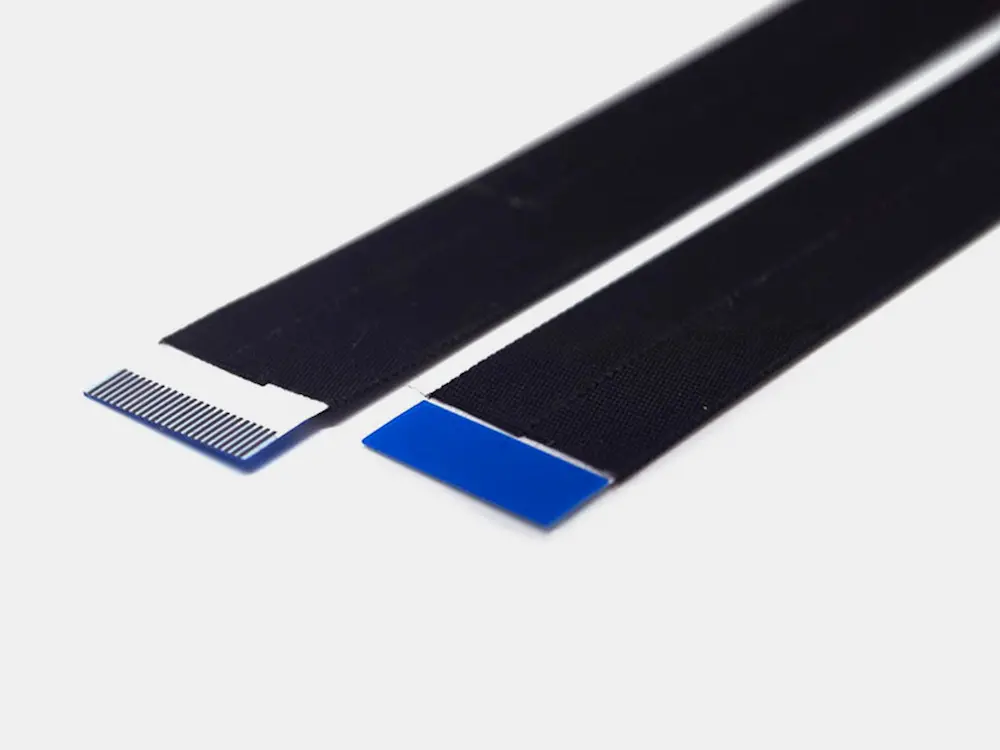
You rely on high-temperature flexible flat cables when you need wiring that withstands intense heat and stays reliable. Material selection makes a difference in how well a flex cable performs in high-temperature environments, especially in automotive or industrial systems. Each flexible flat cable uses specific materials for insulation and conductors, each with its own temperature range:
FEP: Up to 200°C
PI (Polyimide): Up to 250°C
PTFE: Up to 260°C
PET: Up to 150°C
PVC: Up to 105°C
TPE: Up to 125°C
Copper: Up to 200°C
Tin, Silver, Nickel: Up to 260°C
You must match the right high-temperature flexible flat cables to your application to avoid failures. OEMs and engineers look for high-temperature flex cables that offer robust, space-saving, and customizable solutions.
Key Takeaways
Select the right insulation material for your application. FEP, PI, and PTFE are best for extreme heat, while PET and PVC suit standard electronics.
Understand the temperature ratings of conductors. Copper is common, but tin, silver, and nickel plating can enhance performance in high temperatures.
Consider the design and construction of flexible flat cables. Layered designs improve heat resistance and mechanical strength, making them ideal for tight spaces.
Check for certifications like UL and IPC when choosing cables. This ensures safety and compliance for your specific application needs.
Utilize YLS‘s customization options for tailored solutions. You can request specific materials, layouts, and features to meet your project requirements.
Key Materials in High-Temperature Flexible Flat Cables
High-temperature flexible flat cables are specialized wiring solutions designed to maintain performance and reliability in high-temperature environments. You use these cables when you need compact, flexible connections that can handle extreme temperatures without failing.
Key Insulation and Conductor Materials:
Insulation Materials:
FEP (Fluorinated Ethylene Propylene): Handles up to 200°C
PI (Polyimide): Handles up to 250°C
PTFE (Polytetrafluoroethylene): Handles up to 260°C
PET (Polyethylene Terephthalate): Handles up to 150°C
PVC (Polyvinyl Chloride): Handles up to 105°C
TPE (Thermoplastic Elastomer): Handles up to 125°C
Conductor Materials:
Copper: Handles up to 200°C
Tin-plated Copper: Handles up to 260°C
Silver-plated Copper: Handles up to 260°C
Nickel-plated Copper: Handles up to 260°C
Insulation Types: FEP, PI, PTFE, PET, PVC, TPE
You need to choose the right insulation for your flex cable to ensure it survives in high-temperature environments. Each insulation material offers a different maximum temperature and set of properties. The table below shows common insulation materials and their maximum temperature ratings:
Insulation Material | Maximum Temperature Rating |
|---|---|
Polyethylene (PE) | 70°C (158°F) |
Polyvinyl Chloride (PVC) | 80 – 90°C (176 – 194°F) |
Fluorinated Ethylene Propylene (FEP) | 200°C (392°F) |
FEP, PI, and PTFE stand out for their ability to handle extreme temperatures. FEP resists chemicals and heat, making it a top choice for demanding applications. PI, or polyimide, offers excellent thermal stability and flexibility, which is why you often see it in aerospace and automotive wiring. PTFE provides the highest maximum temperature among common insulation materials and resists both heat and chemicals.
PET and PVC are more common in standard electronics. PET insulation works well up to 105°C, which covers most consumer devices. PVC is cost-effective and easy to process, but its temperature rating is lower, so you should avoid it for high-temperature flexible flat cables in harsh environments. TPE offers a balance between flexibility and moderate heat resistance, making it suitable for applications that need both movement and some heat tolerance.
YLS Flexible flat cables use PET insulation for standard products, supporting a temperature rating up to 105°C. For higher demands, YLS can provide advanced insulation options like PI or FEP, which push the temperature rating up to 150°C or more, exceeding typical industry averages.
Tip: When you select insulation, always check the maximum temperature and chemical resistance to match your application’s needs.
Conductor Options: Copper, Tin, Silver, Nickel
The conductor material inside your flex cable determines how well it carries current and resists heat. Copper is the most common choice because it combines high conductivity with good flexibility. For higher temperature or corrosive environments, you can use tin, silver, or nickel plating on copper. These coatings increase the maximum temperature and improve resistance to oxidation.
Copper: Delivers reliable performance up to 200°C. You find it in most high-temperature flexible flat cables.
Tin-plated Copper: Extends the temperature rating to 260°C. It also protects against corrosion.
Silver-plated Copper: Offers the same maximum temperature as tin but with even better conductivity.
Nickel-plated Copper: Handles the highest temperatures and resists harsh chemicals, making it ideal for extreme environments.
YLS Flexible flat cables offer options for copper, tin, and nickel-plated conductors. This flexibility lets you match the conductor to your application’s temperature limit and durability requirements.
Temperature Ratings and Performance
The temperature rating of a flex cable tells you the highest temperature it can handle without degrading. If you use a cable above its temperature limit, you risk insulation breakdown, conductor fatigue, and failure at connection points. Proper material selection helps you avoid these problems and extends the cable’s life.
YLS Flexible flat cables have a standard temperature rating up to 150°C, which is higher than the industry average of 105°C. Advanced designs using silicone tape or polyimide insulation can reach even higher ratings. The table below compares typical temperature ratings for different insulation materials:
Insulation Material | Typical Temperature Rating |
|---|---|
PET | Up to 105°C |
PVC | Up to 105°C |
Polyimide (PI) | Up to 200°C or higher |
FEP | Up to 200°C |
Recent advancements in material science have improved the performance of high-temperature flexible flat cables. High-performance polymers like polyimide and FEP now provide better thermal stability and chemical resistance. Some new cables even use nanomaterials for improved conductivity and flexibility, allowing them to perform reliably in extreme temperatures.
Note: Common failure modes in high-temperature environments include insulation degradation, conductor fatigue, and issues at termination points. Choosing the right materials and jacket materials can help you avoid these risks and ensure long-term reliability.
When you compare costs, flexible flat cables offer a cost-effective solution for most applications. The chart below shows how FFC solutions compare to flex PCB solutions in terms of cost per unit:
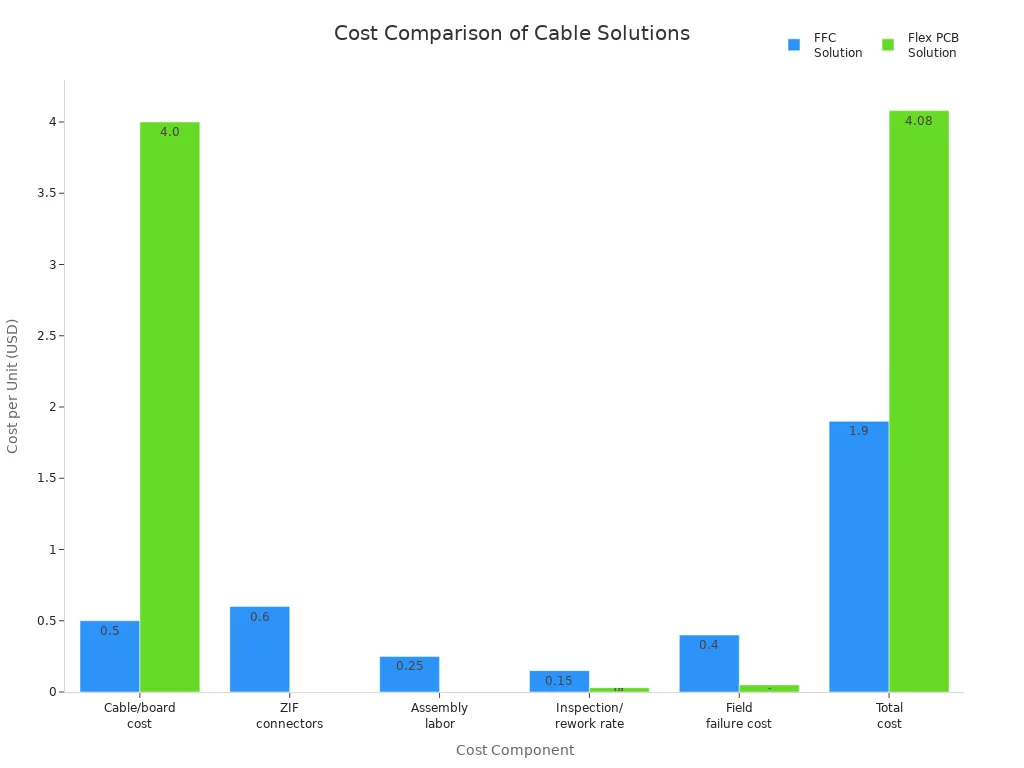
You get a lower total cost per unit with FFCs, especially when you need high-volume production and reliable performance in a wide temperature range.
Cable Design and Heat Resistance
You need to understand how cable design affects heat-resistant properties and durability. Flexible flat cables use layered construction to achieve maximum temperature performance and mechanical strength. Here is a short definition and a bullet list of materials with their temperature ranges:
Definition: Flexible flat cables are made with stacked layers of insulation and conductors, designed to bend and fit into tight spaces while maintaining heat-resistant properties.
Polyimide base: up to 250°C
FEP insulation: up to 200°C
PTFE insulation: up to 260°C
PET insulation: up to 150°C
PVC insulation: up to 105°C
TPE insulation: up to 125°C
Copper conductor: up to 200°C
Tin, Silver, Nickel plating: up to 260°C
Construction Techniques and Layering
You see flexible flat cables built with layers stacked on top of each other. The bottom layer uses polyimide, which bends easily and stays strong. Thin copper lines sit on this base, carrying electricity. A polyimide cover protects the copper from water, dust, and scratches. Glue holds all the layers together, giving the cable structural integrity. This design lets the cable twist and bend, making it ideal for small spaces and frequent movement.
Mechanical durability depends on smart construction. Copper conductors can break if you bend them too much. Insulation may degrade from rubbing, chemicals, or heat. Mechanical pressure from clamps can crush the cable. If the jacket fails, water and dust can enter, causing short circuits. Small bend radii and high cycle rates increase heat generation and wear. Using strong materials and proper cable management improves resistance and extends cable life.
Shielding and Protective Features
Shielding protects your flex cable from electromagnetic interference and adds another layer of defense against heat. You can choose cables with flame-retardant insulation for extra safety. YLS offers customization for heat-resistant flex cable designs. You can select insulation types that withstand maximum temperature up to 125°C. YLS provides multi-core signal and power lines in compact forms, suitable for battery packs and high-density applications.
Tip: When you install cables in confined spaces, choose ultra-thin ribbon cables with low thermal resistance. Make sure there is proper air circulation to minimize heat build-up.
YLS’s customization capabilities let you match cable design to your application. You can request flame-retardant insulation, special shielding, and compact multi-core layouts. These features help you achieve reliable performance in high-temperature environments.
Applications for Heat-Resistant Flex Cable
Automotive and Industrial Uses
You encounter high-temperature flex cables in many automotive and industrial application scenarios. These cables deliver reliable performance in harsh environment applications where heat, vibration, and movement challenge ordinary wiring. You see them in GPS systems, built-in LCD displays, and engine wiring harnesses. Industrial automation systems depend on flex cable for machinery, sensors, and control panels. Space is often limited, and frequent motion demands heat-resistant properties.
When you select cables for automotive or industrial systems, you must consider temperature ranges. Cables for occasional motion operate from -15°C to +70°C. Cables for continuous dynamic flexing, such as in robots or cable chains, work from -25°C to +60°C. Materials like PUR and TPE ensure durability and insulation performance in high-temperature environments.
Here are some typical features of flex cable used in these application scenarios:
Feature | Specification |
|---|---|
Temperature Range | –40°C to +105°C |
Vibration Resistance | Yes |
Certification | UL certified |
Compatibility | ZIF sockets, crimp terminals |
Application | In-vehicle dashboards |
Feature | Specification |
|---|---|
Temperature Range | -40°C to 125°C |
Vibration Resistance | Yes |
EMI Shielding | Yes |
Application | Automotive harness segments |
YLS Flexible Flat Cables support these demanding application scenarios. You find them in ABS, steering, transmission sensors, and energy storage systems. Their flame-retardant insulation and up to 96-pin configuration make them ideal for harsh environment applications.
Medical, Robotics, and Consumer Electronics
You rely on heat-resistant flex cable in medical devices, robotics, and consumer electronics. Medical equipment needs safe, compact wiring for diagnostic and wearable devices. Robotics require cables that endure over 20,000 flex cycles for robotic arms and automated platforms. Consumer electronics benefit from space-efficient, low-profile connectivity in cell phones, laptops, cameras, and flat screen TVs.
Application | Key Features | Performance Metrics |
|---|---|---|
Robotics | High-cycle, bend-resistant operation for robotic arms and automated platforms | Endure over 20,000 flex cycles |
Medical Devices | Safe, compact wiring for diagnostic and wearable devices | ISO-compliant, zero-failure tolerance |
Consumer Electronics | Space-efficient, low-profile connectivity for smart home devices | Supports 2.4GHz Wi-Fi modules, noise-free |
YLS Flexible Flat Cables deliver reliable performance in these application scenarios. You see them in advanced medical devices that require mobility and precision. Their heat-resistant properties ensure safe operation in high-temperature environments. You also find YLS cables in smart home devices, supporting noise-free signal transmission and compact designs.
You can trust YLS to provide flex cable solutions for diverse industries, meeting the needs of automotive, medical, robotics, and consumer electronics.
Selecting the Right YLS Flexible Flat Cable
Choosing the best high-temperature flex cables for your project starts with understanding your environment and technical needs. You want to match the cable’s materials and design to the specific challenges of your application. This ensures safe operation and long-term reliability.
Matching Materials to Application Needs
Start by identifying the temperature rating and environmental factors your flex cable will face. You should consider the following:
The maximum temperature your cable will encounter.
Any chemicals or fluids that may contact the cable.
The level of flexibility or stiffness required for your setup.
Here is a quick reference table to help you select the right materials for different industries:
Industry | Material Requirements |
|---|---|
Automotive | High temperature, vibration, fluids: XLPE insulation, Tin-plated copper |
Aerospace | Extreme temperature, weight, reliability: PTFE/ETFE insulation, Silver-plated copper |
Industrial/Robotics | High flex cycles, oil/EMI: TPE insulation, Spiral shield, Oil-resistant connectors |
Tip: For applications with frequent bending, choose materials like TPE or silicone rubber for better flexibility and durability.
You can also use this bullet list for quick material selection:
PTFE: Handles up to 260°C, best for extreme heat.
Silicone rubber: Flexible, up to 200°C.
XLPE: Good for moderate high-temp, up to 125°C.
Certifications and Compliance
When selecting high-temperature flex cables, always check for certifications. YLS ensures that every heat-resistant flex cable meets UL, IPC, RoHS, and REACH standards. This guarantees safety and global compliance for your electronics. You should also match the voltage and insulation type to your application’s requirements. YLS provides export-ready cables that meet strict industry standards, so you can trust their performance in demanding environments.
Customization and Support
YLS supports you from concept to production. You can request custom pitch, folded layouts, or labeled packaging to fit your unique needs. YLS engineers help you select the right connectors and optimize cable routing for your application. Rapid prototyping and flexible manufacturing let you get samples quickly, so you can test and refine your design. YLS focuses on speed, flexibility, and trust, making it easy for you to get high-performance ribbon cable solutions that fit your exact requirements.
Note: Selecting high-temperature flex cables with the right materials and certifications helps you avoid failures and ensures reliable operation in all your applications.
You need to select the right materials and design for high-temperature flexible flat cables to ensure safe and reliable operation. The table below highlights key factors:
Aspect | Details |
|---|---|
Conductor Material | Copper and silver-plated copper deliver strong performance. |
Insulation Properties | Heat-resistant materials like XLPE protect in tough environments. |
Design Considerations | Smart layering and proper bend radius extend cable life. |
YLS flexible flat cable solutions help you prevent thermal failures and optimize performance. You benefit from proven high flex life, resistance to extreme temperatures, and easier installation. Reach out to YLS for expert advice and tailored cable solutions for demanding applications.
FAQ
What are high-temperature flexible flat cables?
High-temperature flexible flat cables are wiring solutions that handle heat in tough environments.
Common insulation materials and temperature ranges:
FEP: up to 200°C
PI: up to 250°C
PTFE: up to 260°C
PET: up to 150°C
PVC: up to 105°C
TPE: up to 125°C
Which industries use these cables the most?
You find these cables in automotive, industrial automation, robotics, medical devices, and consumer electronics. They work well where space is tight and heat is a concern.
How do you choose the right insulation material?
You should check the maximum temperature your application reaches. Match the insulation material to that temperature. For example, use PTFE for extreme heat or PET for standard electronics.
What makes YLS Flexible Flat Cables reliable?
YLS uses high-quality materials, advanced construction, and strict testing. You get cables that resist heat, flex without breaking, and meet global standards.
Can you customize YLS cables for special projects?
Yes! You can request custom pitch, length, shielding, or labeling. YLS supports rapid prototyping and works with you to meet your exact needs.
